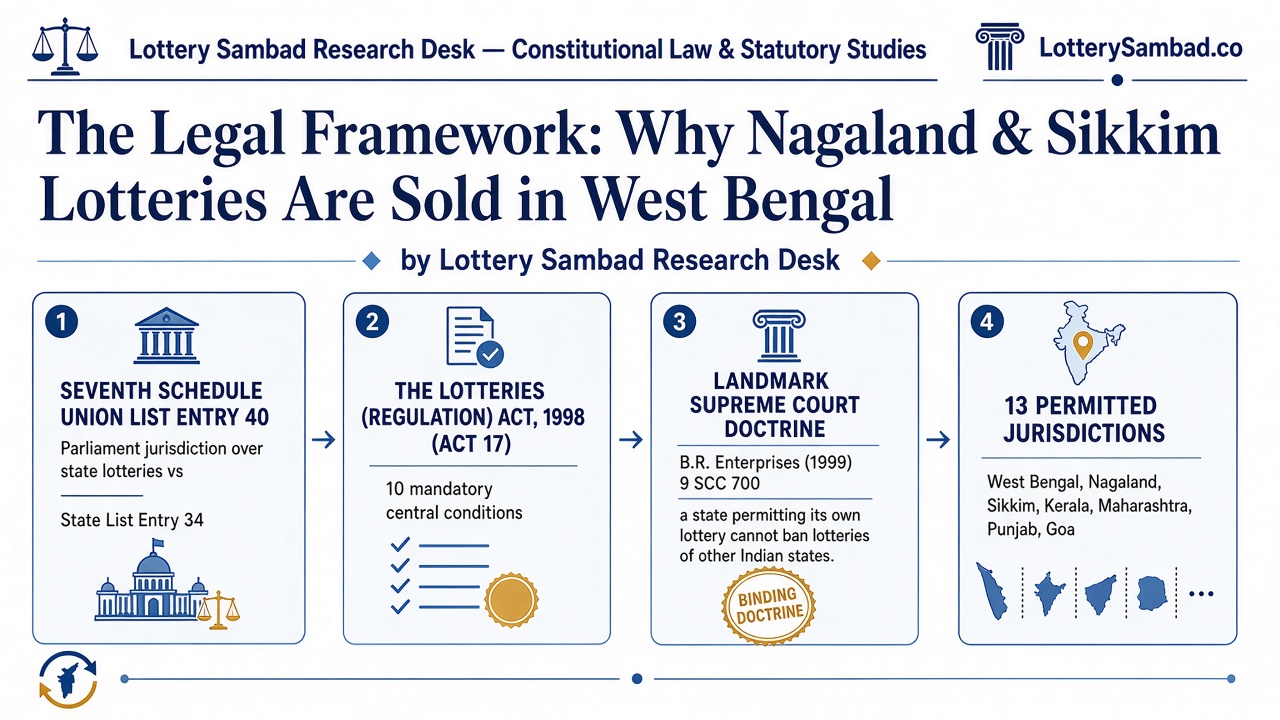
1. Constitutional Division of Powers: Entry 40 vs Entry 34
The foundation of India's lottery jurisprudence lies in the Seventh Schedule of the Constitution of India, which divides legislative authority between the Parliament and State Legislative Assemblies:
- Seventh Schedule, List II (State List), Entry 34: Grants State Assemblies legislative power over "Betting and gambling". Under this entry, states may regulate or prohibit casinos, card rooms, and sports betting.
- Seventh Schedule, List I (Union List), Entry 40: Grants the Parliament of India exclusive authority over "Lotteries organised by the Government of India or the Government of a State".
Because Entry 40 sits on the Union List, individual state governments have zero authority to regulate or legislate on state-organized lotteries unless Parliament explicitly delegates that power through central legislation. Private lotteries, conversely, fall under Entry 34 and are banned nationwide under Section 294A of the Indian Penal Code (now Bharatiya Nyaya Sanhita).
2. The Lotteries (Regulation) Act, 1998: The 10 Mandatory Conditions
To prevent fraud and maintain governmental oversight, Parliament enacted The Lotteries (Regulation) Act, 1998. Under Section 4 of the Act, a state lottery is legal if and only if it satisfies ten non-negotiable criteria:
- Prizes cannot be offered on any pre-announced number or on the basis of a single digit.
- The state government must print the lottery tickets bearing the official state emblem and facsimile signatures of authorized state officers.
- The state government must sell the tickets either directly or through registered sole selling distributors appointed via public tender.
- All sales proceeds, after deducting distributors' commissions, must be directly credited into the Consolidated Fund / Public Account of the organizing State.
- The draw must be conducted within the territory of the organizing State (or an authorized state government building) under the physical supervision of a panel of government judges.
- No lottery can have more than one draw in a week (later modified for paper lotteries to permit up to 24 draws weekly under Central Rules 2010).
- Bumper draws cannot exceed six in a financial year.
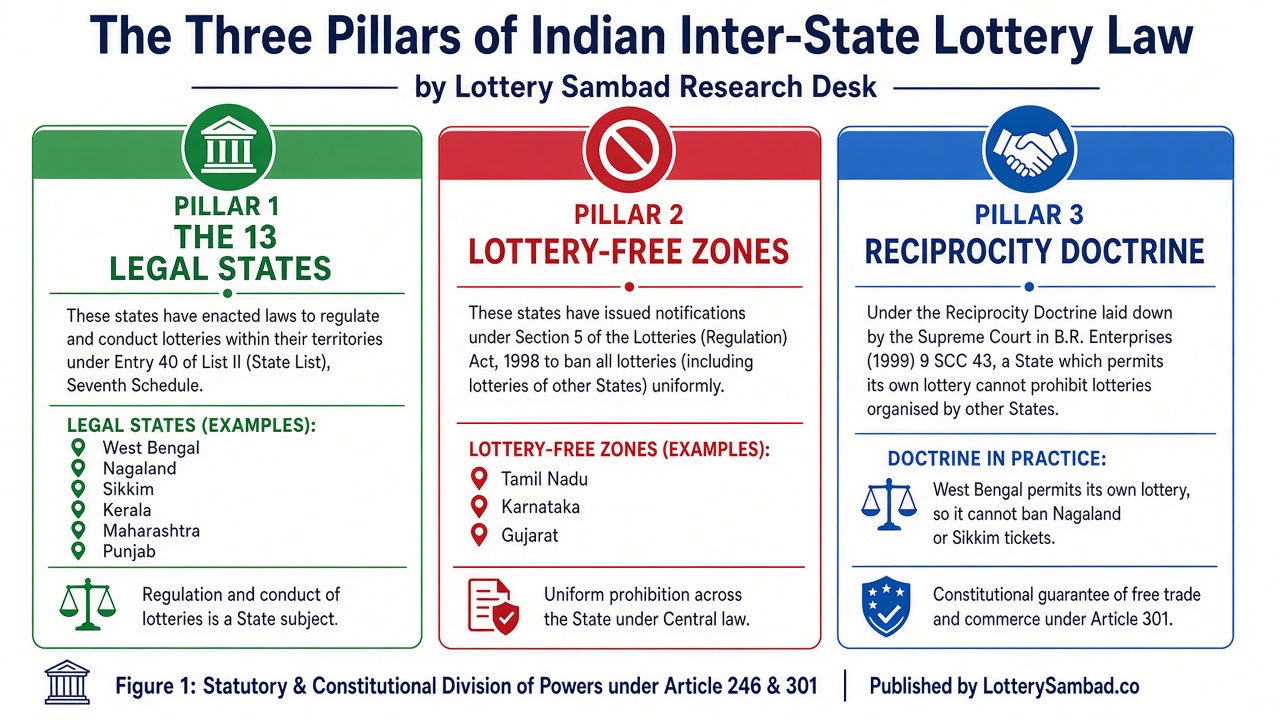
Figure 1: Constitutional division of powers and Supreme Court doctrine on 13 legal states versus lottery-free zones.
3. The Landmark B.R. Enterprises Ruling & The "Lottery-Free Zone" Doctrine
The legal linchpin permitting Nagaland and Sikkim tickets to be sold in West Bengal was forged in the Supreme Court of India's landmark verdict in B.R. Enterprises v. State of U.P. (1999) 9 SCC 700.
Under Section 5 of the 1998 Act:
"A State Government may, within the State, prohibit the sale of tickets of a lottery organised, conducted or promoted by every other State."
In B.R. Enterprises, the Supreme Court held that Section 5 is constitutional, but introduced a strict judicial condition known as the Reciprocity Principle:
- A State Government can prohibit the sale of tickets of other states only if it first prohibits the sale of its own lotteries within its territory.
- A State cannot be hypocritical: it cannot run its own state lottery to enrich its treasury while banning lotteries from sister states to protect its domestic monopoly.
- Therefore, a State must choose between two stark choices: either become a 100% "Lottery-Free Zone" (banning all lotteries uniformly, as done by Tamil Nadu and Karnataka) or keep its borders open to all compliant State lotteries.
Because the State of West Bengal chose not to declare itself a lottery-free zone, it has no legal power under the Constitution or Central Act to block tickets printed by Nagaland or Sikkim.
4. The Res Extra Commercium Doctrine
A frequent constitutional challenge mounted by lottery distributors has been to claim protection under Article 19(1)(g) (the fundamental right to practice any trade or business) and Article 301 (freedom of inter-state trade and commerce).
The Supreme Court has consistently rejected this argument under the ancient doctrine of Res Extra Commercium (things outside commerce). In State of Bombay v. R.M.D. Chamarbaugwala (1957) and reiterated in State of Karnataka v. State of Meghalaya (2022), the Court established:
- Gambling, betting, and lotteries are activities that are inherently pernicious (vices) and do not qualify as "trade, commerce, or intercourse" in the constitutional sense.
- No citizen or corporation possesses a fundamental right under Article 19(1)(g) to conduct lottery sales.
- State governments conduct lotteries solely by virtue of statutory privilege granted by Parliament under Entry 40 of List I.
5. The GST Framework and State Revenue Contributions
Prior to 2017, inter-state lotteries suffered from complex, overlapping state taxes. Under the Goods and Services Tax (GST) regime instituted by the GST Council:
- Unified 28% GST Rate: All lottery tickets in India are taxed at a uniform rate of 28% GST on the face value of the ticket.
- Destination Principle: Under the Integrated GST (IGST) framework, the 14% State GST (SGST) component of lottery tickets sold in West Bengal flows directly into the treasury of the Government of West Bengal, generating thousands of crores of rupees in annual consumption tax revenue.
- Non-Tax Revenue for Organizing States: For smaller mountainous states like Nagaland and Sikkim with limited industrial bases, draw fees and distributor tenders contribute over 10% to 15% of total state non-tax budgetary revenues, funding hospitals, schools, and mountain highways.
Summary for Observers & Players
The presence of Nagaland and Sikkim lotteries in West Bengal is not an informal loophole, but the direct execution of Indian constitutional law under Entry 40 of List I and The Lotteries (Regulation) Act, 1998. The industry operates under continuous scrutiny from state directorates, GST authorities, and the Supreme Court, ensuring that every genuine ticket sold is backed by sovereign state guarantees.