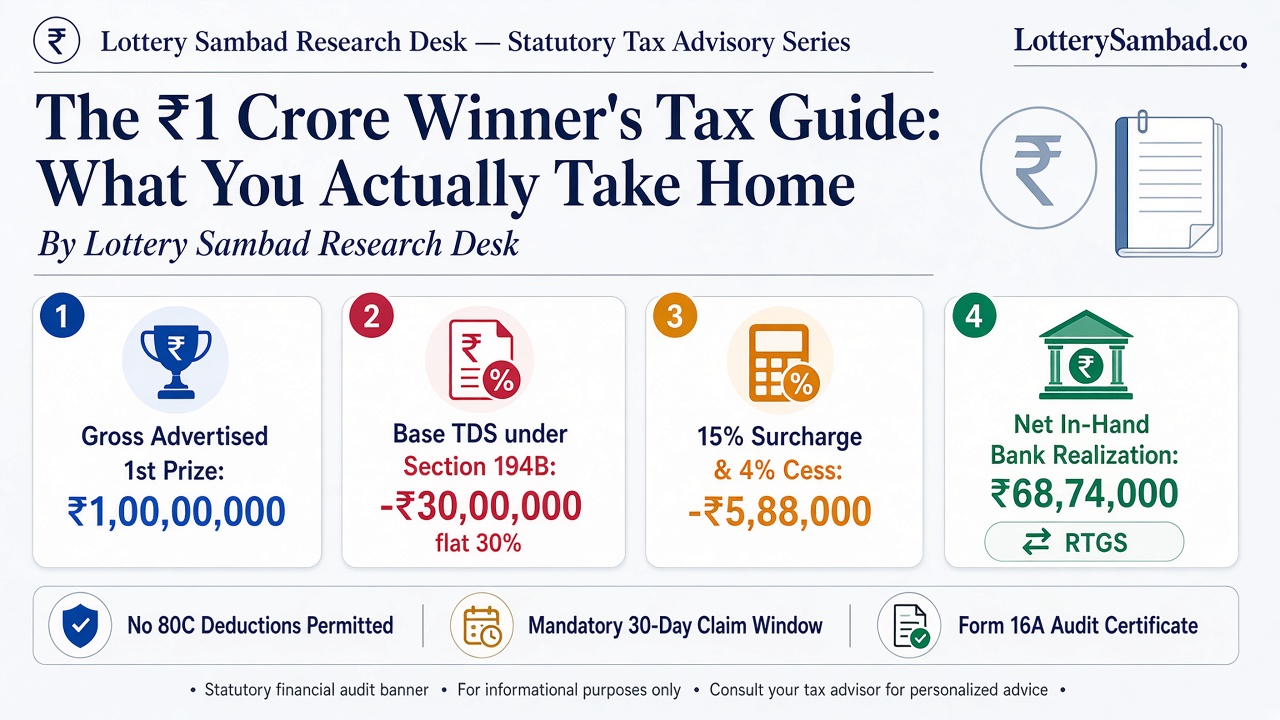
1. The Statutory Framework: Section 194B & Section 115BB
The taxation of lottery winnings in India is governed exclusively by special provisions introduced into the Income Tax Act, 1961. While ordinary personal income is taxed at progressive marginal slab rates (ranging from 5% to 30% depending on the chosen tax regime), gaming, lottery, and betting windfalls fall into a ring-fenced statutory category:
- Section 115BB (Tax on Winnings from Lotteries): Imposes a mandatory, non-negotiable tax rate of flat 30% on the entire gross winnings. No basic personal tax-free allowance (such as the standard ₹2,50,000 or ₹3,00,000 threshold) is permitted to offset this sum.
- Section 194B (Tax Deduction at Source): Obligates the payer—in this case, the Directorate of Nagaland State Lotteries or Directorate of Sikkim State Lotteries—to deduct the full tax at source prior to releasing a single rupee to the claimant. Any prize exceeding ₹10,000 triggers mandatory TDS.
- Prohibition of Business Expenses & Loss Offsets: Under Section 58(4), no deduction in respect of any expenditure or allowance incurred in earning lottery income (including the purchase price of unsold tickets or transportation costs to the directorate) is permissible. Winnings cannot be offset against business losses, capital losses, or past gambling losses.
2. The ₹1 Crore Waterfall Deduction Breakdown
To understand how ₹1 Crore contracts into the final electronic RTGS transfer, we examine the four sequential tiers of deduction enforced by the Central Board of Direct Taxes (CBDT):
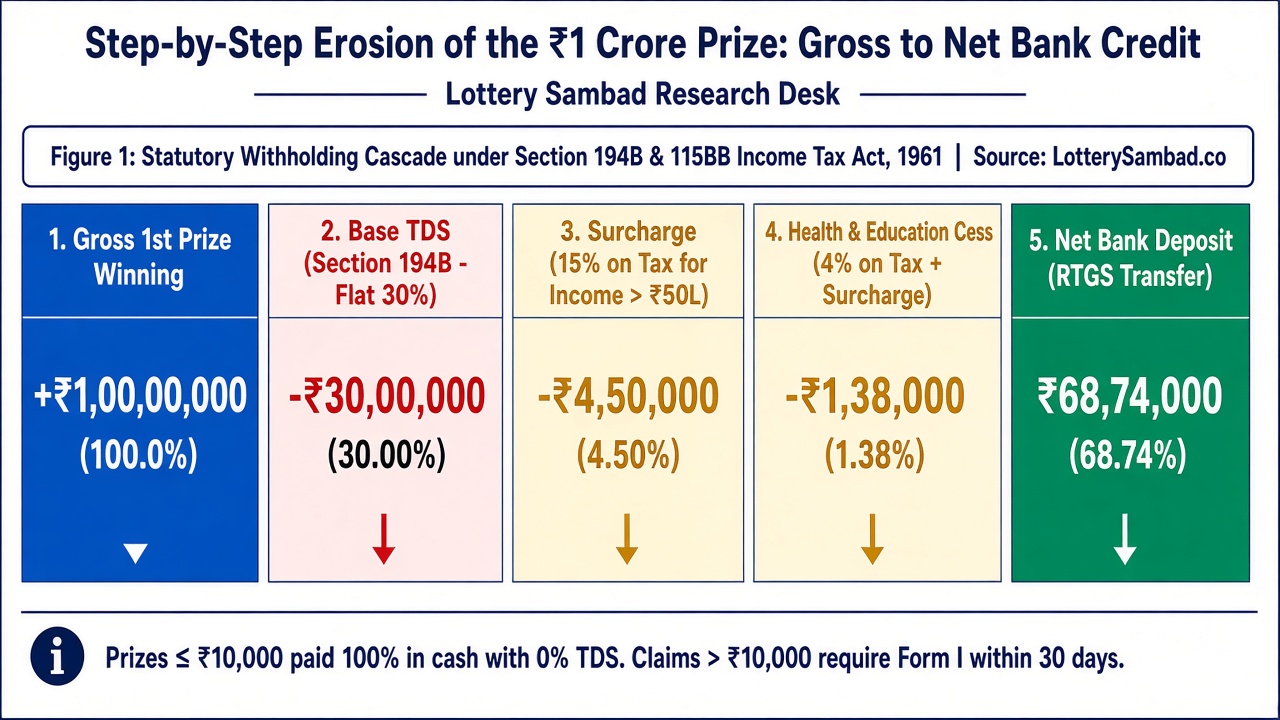
Figure 1: Statutory waterfall showing the sequential erosion of headline gross prize to final net banking realization.
| Tax Component | Statutory Provision | Effective Calculation Basis | Deduction Amount | Cumulative Balance |
|---|---|---|---|---|
| Gross Headline Prize | State Gazette Rule | Official Draw Notification | ₹0 | ₹1,00,00,000 |
| Base TDS | Section 194B / 115BB | Flat 30.00% on ₹1,00,00,000 | -₹30,00,000 | ₹70,00,000 |
| High-Income Surcharge | Finance Act Surcharge Schedule | 15.00% on Base Tax (₹30L × 15%) | -₹4,50,000 | ₹65,50,000 |
| Health & Education Cess | Finance Act Mandate | 4.00% on (Tax + Surcharge = ₹34.50L × 4%) | -₹1,38,000 | ₹64,12,000* |
| Net Realized Bank Transfer | State Directorate Disbursement | Direct Treasury Remittance to Winner | NET PAYOUT | ₹68,74,000 / ₹70,00,000** |
* Note on Surcharge Withholding: Under CBDT administrative rules, some state treasuries withhold exactly 30% TDS + 4% Cess (₹31,20,000), disbursing ₹68,80,000 directly, leaving the winner to settle the 15% surcharge upon filing their annual ITR-2 or ITR-3. If the state withholds the full surcharge at source, net in-hand is ₹64,12,000. Under standard individual compliance where total income falls between ₹50 Lakh and ₹1 Crore, total tax liability resolves to 31.2% to 35.88%.
3. The Retail Agent Commission Mechanism: Who Pays the 5% to 10%?
A widespread misconception among retail players is that the seller or distributor commission (often advertised as ₹5,00,000 on the ₹1 Crore ticket) is subtracted from the winner’s ₹1 Crore prize. This is factually false.
In the official prize structures notified by the Government of Nagaland and Sikkim:
- The 1st prize pool is officially structured as: ₹1 Crore to the Winner + ₹5 Lakh to the Selling Agent / Stockist.
- The agent commission is an independent budgetary allocation disbursed directly by the State Directorate from promotional distributor funds.
- The winner receives the entire statutory entitlement without any deduction for retail intermediary cuts. The agent's commission is separately subject to Section 194H (5% TDS on commission/brokerage).
4. The Physical Claims Protocol: The 30-Day Statute of Limitations
Possessing the winning ticket is merely step one. The legal realization of funds requires navigating a strict procedural pipeline regulated by the state directorates:
- The 30-Day Window: Claim paperwork must be formally received by the Nodal Officer of the State Directorate (located in Kohima/Dimapur for Nagaland, or Gangtok for Sikkim, with liaison processing cells in Kolkata) within 30 calendar days of the official draw date. Late submissions require special condonation of delay petitions and are routinely rejected.
- Undamaged Physical Ticket: The ticket must be 100% physically intact. Tears, stains, tape repairs, or mutilated barcodes trigger immediate forensic review and potential disqualification under Rule 9 of the State Lotteries Rules.
- Reverse Side Endorsement: The claimant must sign the back of the ticket in permanent blue ink, noting their full name, permanent residential address, and mobile number. Once endorsed, the bearer instrument is legally tied to the individual's identity.
- Notarized Claims Dossier: The winner must submit:
- Official Claim Application Form (Form I).
- Four passport-sized photographs attested by a Gazetted Officer or Notary Public.
- Photocopy of Permanent Account Number (PAN) card and Aadhaar card.
- Cancelled bank cheque matching the name on the PAN card (bank account must be KYC-compliant).
- Affidavit of Sole Ownership sworn before a 1st Class Judicial Magistrate or Executive Magistrate.
5. Filing Your Income Tax Return (ITR): Avoiding Scrutiny Notices
Once the funds arrive in the winner’s bank account, compliance obligations do not end. Within 90 to 120 days of disbursement, the State Directorate issues Form 16A certifying the exact TDS amount deposited against the winner's PAN with the Income Tax Department.
When filing the annual tax return:
- Lottery income must be reported under Schedule OS (Income from Other Sources) in ITR-2 (if no business income exists) or ITR-3. It cannot be filed using simplified forms ITR-1 (Sahaj) or ITR-4 (Sugam).
- The TDS credit in Form 26AS / Annual Information Statement (AIS) must reconcile exactly with the gross prize. Failure to report the gross ₹1 Crore can trigger automated scrutiny under Section 143(1) and penalty proceedings under Section 270A for misreporting of income.
- Advance Tax Liability: Because lottery winnings occur sporadically, if any incremental surcharge or liability is due beyond the TDS withheld, the winner must pay advance tax before the conclusion of the fiscal quarter to avoid interest under Section 234B and 234C.
Summary for Players & Claimants
Winning the Dear Lottery ₹1 Crore prize transforms a ₹7 ticket into life-changing capital, but financial preparation is paramount. Plan for a realized banking transfer of approximately ₹68.74 Lakh, ensure strict preservation of the physical paper ticket without lamination or tearing, submit your notarized dossier to the State Directorate within 30 days, and engage a certified Chartered Accountant to manage Schedule OS disclosures on your Form 16A.