Fake vs Real Dear Lottery Ticket: 7 Physical & Digital Security Checks
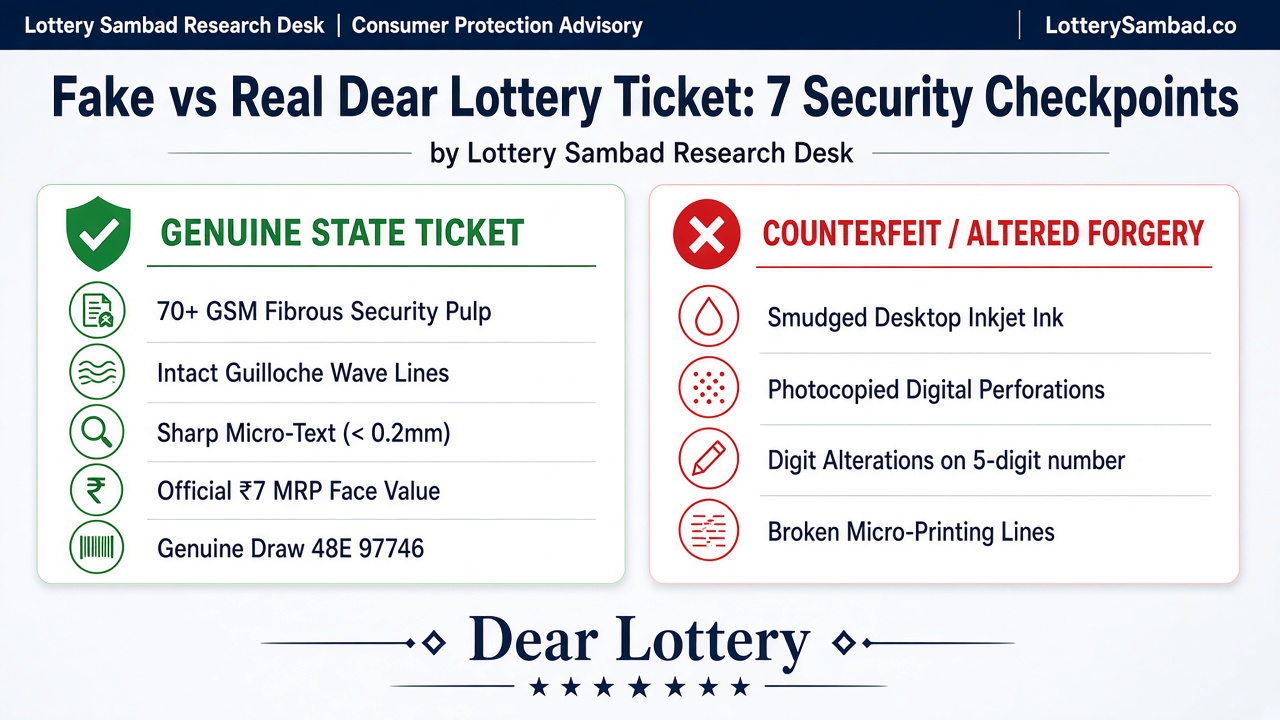
1. The 7-Point Forensic Inspection Checklist
Whether you are purchasing tickets at a neighborhood counter or verifying a potential high-tier prize claim, perform these seven systematic checks:
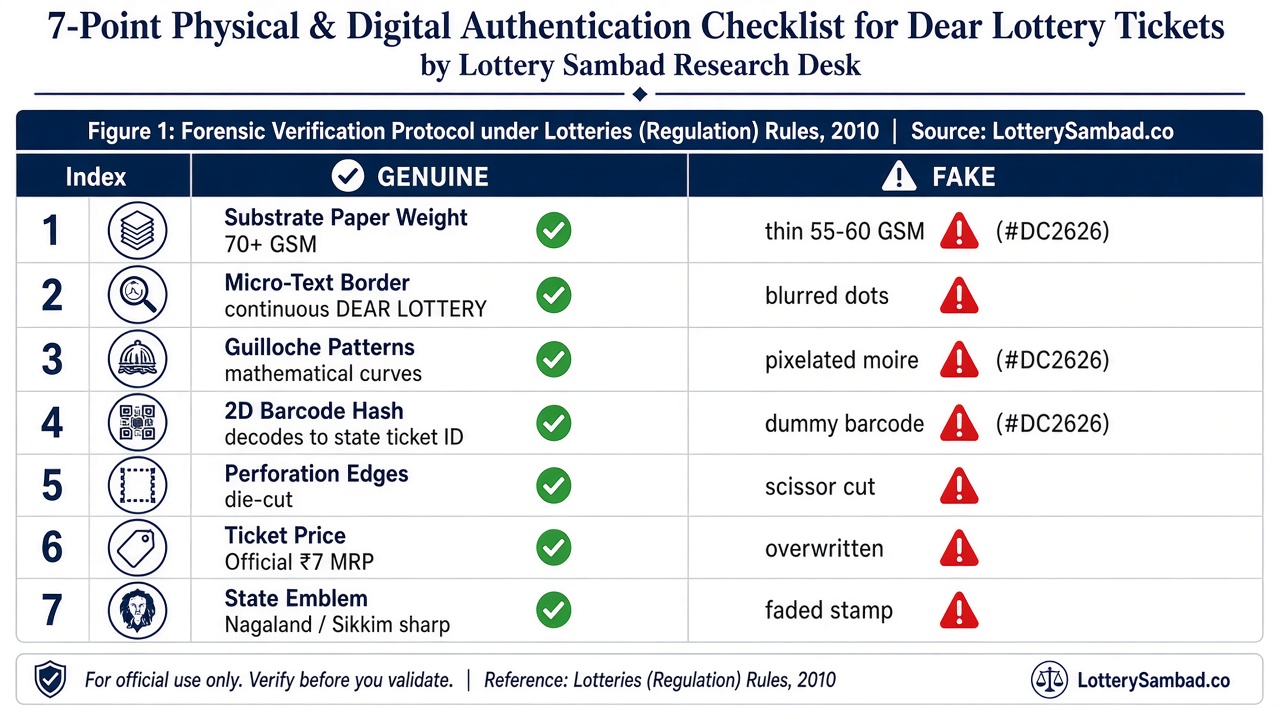
Checkpoint 1: Micro-Text Border Engraving
Examine the thin border lines surrounding the ticket using an ordinary smartphone camera zoom (5x) or a 10x magnifying loupe. On authentic tickets, what looks like a solid line is actually a continuous, razor-sharp repeating string: NAGALAND STATE LOTTERIES or SIKKIM STATE LOTTERIES printed in sub-0.2mm typography. Counterfeits created via office scanners reproduce this as a blurry grey smear or jagged dot matrix.
Checkpoint 2: Guilloche Lathe Rosette Waves
Behind the ticket's center numbers runs an intricate background of interlocking mathematical curves (guilloche waves). These curves are generated by mechanical geometric lathes and printed with special security inks. Genuine lines never cross with ink bleed; fake scans show telltale moiré patterns (wavy distortion grids caused by digital scanner sensors).
Checkpoint 3: The Encrypted 2D Barcode Hash
Beneath the winning digits sits a high-density 2D matrix barcode. On genuine tickets, scanning this barcode with an official verification scanner decodes the exact draw time, draw date, batch serial, and cyclic redundancy check (CRC) hash. Fraudulent tickets frequently feature static dummy barcodes that produce decoding errors or lead to unrelated websites.
Checkpoint 4: Paper GSM Weight & Fiber Feel
Authentic state lottery tickets are printed on specialized 70 to 80 GSM wood-pulp security paper. It produces a distinct crisp snap when flicked between thumb and forefinger. Counterfeiters routinely cut corners using lightweight 45–60 GSM photocopy sheets, which feel noticeably limp, smooth, and easily transmit backlight.
Checkpoint 5: Left-Edge Punch Perforations
All genuine tickets are bound into stitched booklets of 25, 50, or 100 slips at government-approved security printing presses. When torn out by the street vendor, the left margin must display genuine rough paper "teeth" (fibrous tear perforations). If a ticket's left margin is razor-straight without perforation teeth, it was likely sliced from an office printer sheet.
Checkpoint 6: Impact Indentation on Serial Digits
The five main serial digits (e.g., 79258) are stamped using high-speed mechanical numbering boxes. If you run your fingernail over the back of the ticket directly behind the numbers, you will feel a faint mechanical indentation (relief strike). Chemically altered tickets or digital inkjet prints are completely flat on both sides.
Checkpoint 7: Cross-Referencing Official PDF Gazettes
The ultimate verification check: never rely solely on a printout or screenshot sent via messaging apps. Cross-reference the draw number, draw time, and winning series directly against the signed government gazette available on our Instant Ticket Checker and official Gazette PDF Archive.
2. Statutory Action: Dealing with Suspected Fraud
Manufacturing, distributing, or attempting to claim prize money with a forged lottery ticket is a serious criminal offense punishable under Section 420 (Cheating) and Section 471 (Using as genuine a forged document) of the Indian Penal Code, carrying penalties of up to seven years of rigorous imprisonment.
Steps for Victims and Whistleblowers:
- Do Not Alter the Evidence: Keep the suspect ticket in its original state. Do not write on it, tape it, or laminate it.
- Note Counter Details: Document the exact location, shop banner, and purchase timestamp.
- Verify Against Official Results: Check whether the numbers appeared on the official draw sheet on
LotterySambad.co. - Lodge Formal Complaint: Submit the physical evidence to the local Cyber Cell / Police Station and email the Directorate of State Lotteries.